
How to Pay Off Debt Fast UK: Snowball vs Avalanche
Two proven methods to pay off debt in the UK fast: snowball vs avalanche.

By Hammad Younas
Published · Last updated · 7 min read
Fact-checked by Hammad Younas
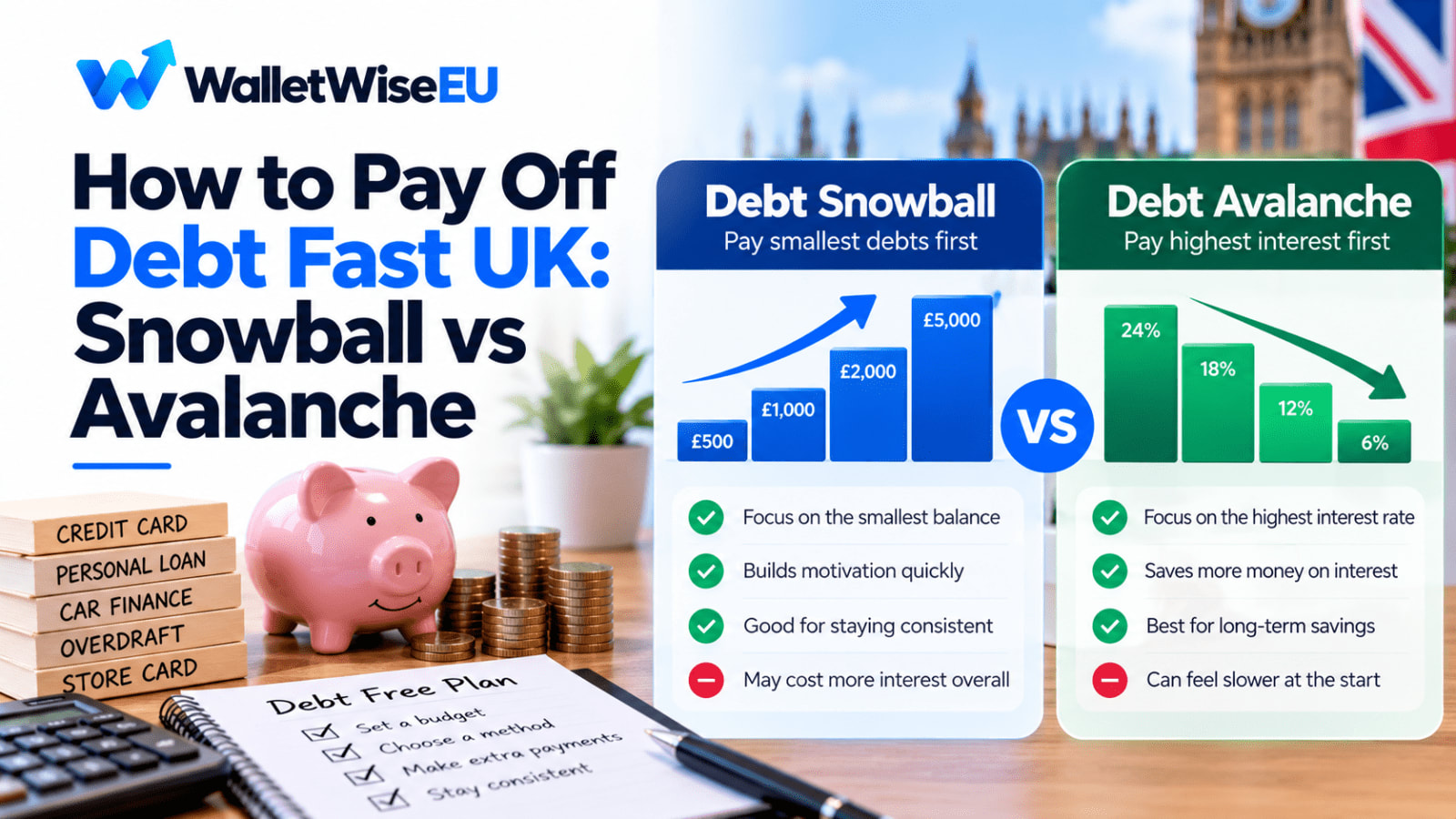
Two in five UK adults carry unsecured debt right now, according to the FCA. Knowing you should pay it off is straightforward enough. Working out exactly how to do it is a different matter entirely. This guide on how to pay off debt UK walks through two proven methods, snowball and avalanche, with a real worked example using typical UK debt figures, so you can choose the right approach for your situation and get started today.
How to Pay Off Debt UK: Start With This One List
Before settling on any method, you need a single list. Write down every debt you carry. For each one, record:
Debt | Balance | APR | Min Payment/Month |
|---|---|---|---|
Store card | £400 | 39.9% | £10 |
Credit card | £1,800 | 24.9% | £36 |
Personal loan | £4,200 | 16.9% | £84 |
That list is the foundation. Nothing works without it.
Now divide your debts into two categories: priority and non-priority. Priority debts in the UK include council tax, rent, mortgage arrears, and energy bills. Failing to pay these carries serious consequences, including bailiffs, eviction, and disconnection. Priority debts always come first, before applying any method to anything else.
Non-priority debts cover things like credit cards, store cards, and personal loans. They still matter, but missing a payment does not put a roof over your head at risk. The snowball and avalanche methods both apply to non-priority debt once your priority bills are covered.
One more thing to check before you begin: if you have credit card debt sitting at 30 to 40 percent APR, it may be worth exploring whether a 0 percent balance transfer card is available to you first. More on that below.
The Debt Snowball Method UK: How It Works
The debt snowball method in the UK works by ordering your debts from smallest balance to largest, paying the minimum on all of them while directing every spare pound at the smallest one until it is cleared.
Here is the step-by-step:
List debts from smallest balance to largest (ignore interest rates for now)
Pay the minimum on every debt except the smallest
Put every extra pound you have toward the smallest debt
When it is cleared, roll that full payment to the next smallest
Repeat until all debts are gone
Using the example above with a monthly surplus of £150:
Month | Store Card (£400) | Credit Card (£1,800) | Personal Loan (£4,200) |
|---|---|---|---|
Start | £400 | £1,800 | £4,200 |
Month 3 | Cleared | £1,728 | £4,050 |
Month 14 | Gone | Cleared | £3,400 |
Month 30 | Gone | Gone | Cleared |
The store card at £400 disappears in roughly 2.5 months with the extra £150 on top of the £10 minimum. That first win carries more weight than people expect. Seeing a debt removed from your list changes how you approach the whole process.
The honest downside: because interest rates are ignored, you may be leaving a 39.9 percent store card untouched while you attack a 16.9 percent loan. That costs more in total interest. But if sticking to a plan has been a struggle before, the momentum of early wins often makes the difference.
The Debt Avalanche Method UK: How It Works
The debt avalanche method in the UK takes a different approach. You rank debts by interest rate from highest to lowest and go after the most expensive one first, regardless of how large the balance is.
Here is the step-by-step:
List debts from highest APR to lowest APR
Pay the minimum on every debt except the highest-rate one
Put every extra pound toward the highest-APR debt
When it is cleared, roll the full payment to the next highest APR
Repeat until all debts are gone
Using the same example with £150 surplus:
Month | Store Card (39.9%) | Credit Card (24.9%) | Personal Loan (16.9%) |
|---|---|---|---|
Start | £400 | £1,800 | £4,200 |
Month 3 | Cleared | £1,728 | £4,050 |
Month 13 | Gone | Cleared | £3,500 |
Month 28 | Gone | Gone | Cleared |
In this example, because the highest-rate debt (the store card) also happens to be the smallest balance, the avalanche method clears it at almost the same pace as snowball. The real saving comes through the middle debts. By clearing the 24.9 percent credit card before the personal loan, you save roughly £300 to £500 in total interest compared to the snowball order.
The honest downside: if your highest-rate debt also carries the largest balance, months will pass before anything disappears from your list. That takes discipline to sustain.
Snowball vs Avalanche: Which One Should You Choose?
This is the straightforward answer to how to pay off debt UK: both methods work. The one that works better for you depends as much on your psychology as on the maths.
Snowball | Avalanche | |
|---|---|---|
Best for | People who need motivation | People focused on total cost |
Interest cost | Higher | Lower |
First win timeline | Faster | Slower (if biggest debt = highest rate) |
Requires discipline | Low to medium | Medium to high |
Maths complexity | Simple | Slightly more involved |
Use the snowball method if:
You have several small debts you can clear quickly
You have found it hard to stick to a debt plan before
The interest rate difference between your debts is small (under 10 percentage points)
Use the avalanche method if:
One debt has a significantly higher APR than the others
You are confident you can stay motivated without early wins
The total interest saving is large enough to matter to your situation
Here is a one-question decision test: is the APR on your most expensive debt more than 10 percentage points higher than your cheapest? If yes, the avalanche saves you meaningful money. If no, go with snowball for the psychological momentum. For a good number of people, the answer will point to avalanche, because store cards often sit at 30 to 40 percent while personal loans run at 10 to 20 percent.
Other Options Worth Knowing: Balance Transfers and Consolidation
Two tools can work alongside either method and speed up results.
0 percent balance transfer cards
If you have credit card debt at 20 to 40 percent APR, moving it to a 0 percent balance transfer deal removes interest entirely during the promotional period. In October 2026, the best deals offer 18 to 24 months at 0 percent, with a transfer fee of around 2 to 3 percent of the balance. That fee is almost always worth paying compared to months of high-rate interest.
The key rule: keep paying the minimum every month, and aim to clear the balance before the 0 percent period ends, because the revert rate is usually 20 to 25 percent.
Debt consolidation loans
A consolidation loan rolls multiple debts into one monthly payment, often at a lower overall rate. It can work well when it genuinely reduces your average APR. One warning you need to know: never consolidate unsecured debt (credit cards, personal loans) into a loan secured against your home. If payments become difficult, you put your home at risk. Use only unsecured consolidation products.
For anyone whose debt has become unmanageable, StepChange and MoneyHelper both offer free, impartial debt advice in the UK.
Your Debt Payoff Action Plan for Today
The most practical tip for paying off debt in the UK right now is to take five specific steps, starting today even if you can only put an extra £10 toward it this week:
Write down every debt with its balance, APR, and minimum payment using the table format from the first section
Separate priority debts from non-priority debts and make sure priority ones are covered first
Check whether any high-APR credit card debt qualifies for a 0 percent balance transfer before you commit to a repayment order
Choose snowball or avalanche using the 10 percentage point test from the comparison section
Set up your first extra payment today, even if it is small, because starting is the only thing that matters right now
If you have already been managing your monthly budget carefully and want to find extra money to put toward debt, see the full breakdown of how to reduce energy bills this winter, which could free up £20 to £50 a month that goes straight to your repayment plan.
We also covered what the autumn budget 2026 means for household finances in detail, including any changes to benefits or tax thresholds that might affect your repayment capacity.
Knowing how to pay off debt in the UK is straightforward once you have that first list in front of you. The debt does not disappear overnight, but it shrinks every single month you stick to the plan. And that is the only thing that matters: not the perfect method, just the one you will actually follow through on.
This article is for informational purposes only and does not constitute financial advice. Always seek independent financial guidance before making money decisions.
This article is for general information only and is not financial, tax or legal advice. Rules and rates vary by country and change over time.